Key points
- Each model invoice was worth exactly €10,000 at the October 27 reference rate; its foreign-currency amount then stayed fixed.
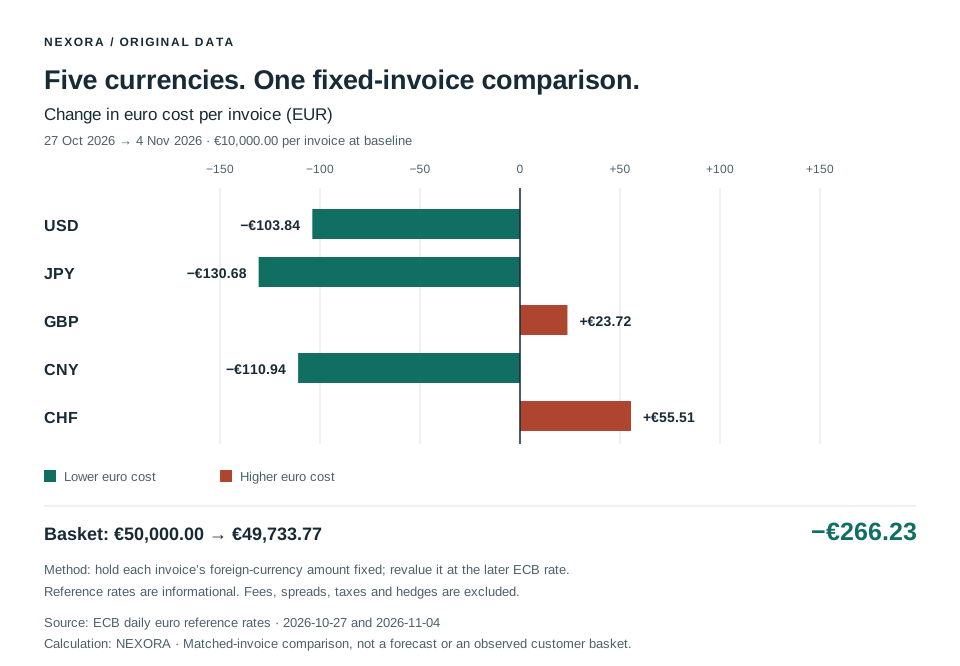
- By November 4, the yen bill cost €130.68 less and the franc bill €55.51 more; the other currencies moved by different amounts.
- The calculation uses public ECB reference data and excludes provider charges, contract repricing and hedging.
Start with the invoice
A euro-based buyer watching the dollar alone could have missed a small but important reversal elsewhere in the budget. Between October 27 and November 4, the ECB reference quotes would have reduced the euro cost of our model dollar, yen and yuan invoices. The same calculation increased the cost of our sterling and Swiss franc invoices. Five exposures held through the same eight calendar days produced five separate cash consequences.
We constructed each invoice to equal exactly €10,000 at the October 27 reference rate. We then kept its foreign-currency amount fixed and recalculated its euro cost on November 4. The largest reduction in this five-currency sample was €130.68 for the yen invoice. The largest increase was €55.51 for the franc invoice. These are calculations from public data, not records of payments made by a business.
My position is straightforward: a purchasing budget should begin with the currencies and dates of its actual obligations. A broad description of the euro can be useful context, but it does not specify which invoice becomes easier to pay. Our exercise makes that distinction visible without trying to forecast the next exchange-rate move.
A matched starting point
The ECB quotes these currencies as units of foreign money per euro. On October 27, one euro corresponded to 1.115 US dollars, 175.97 yen, 0.83658 pounds, 7.4343 yuan and 0.9239 Swiss francs. Multiplying each quote by €10,000 gives five different invoice amounts with an identical initial euro value. That common starting value allows the later euro changes to be compared on the same scale.
The dollar invoice is therefore $11,150, while the yen invoice is ¥1,759,700. The sterling, yuan and franc invoices are £8,365.80, CNY74,343 and CHF9,239. An exercise using 10,000 units of every currency would instead compare obligations with dramatically different initial values. A €50 movement in one of those bills would mean something very different from €50 in another.
Holding the foreign amount constant is essential. We are examining an agreed foreign-currency liability, not assuming that a supplier continuously changes its price to preserve a euro value. The model also assumes an unhedged buyer with no offsetting receipts in that currency. A business with different contract terms needs a different calculation before it can apply the result.
The two quotes become five euro outcomes
On November 4, the five quotes were 1.1267 dollars, 178.30 yen, 0.83460 pounds, 7.5177 yuan and 0.9188 francs per euro. Dividing each fixed invoice by its new quote gives the comparison cost. The dollar invoice falls to €9,896.16, the yen invoice to €9,869.32 and the yuan invoice to €9,889.06. Sterling rises to €10,023.72 and francs to €10,055.51.
The percentage changes are calculated from unrounded costs. They are approximately −1.0384%, −1.3068% and −1.1094% for the dollar, yen and yuan bills, and +0.2372% and +0.5551% for sterling and francs. Final displayed money amounts are rounded to cents. Rounding the inputs prematurely would make a small movement look less precise than the underlying exercise permits.
A higher foreign-currency-per-euro quote lowers the euro cost of a fixed foreign invoice. That reciprocal relationship explains why the percentage change in the invoice is not simply the negative of the percentage change in the quoted exchange rate. The distinction is modest over this interval, but a spreadsheet should still use division by the comparison quote rather than approximate the answer from a headline percentage.
| Currency | Fixed foreign invoice | Oct 27: units / EUR | Nov 4: units / EUR | Nov 4 euro cost | Euro change | Cost change |
|---|---|---|---|---|---|---|
| USD | 11150.00 | 1.115 | 1.1267 | €9896.16 | −€103.84 | -1.0384% |
| JPY | 1759700.00 | 175.97 | 178.3 | €9869.32 | −€130.68 | -1.3068% |
| GBP | 8365.80 | 0.83658 | 0.8346 | €10023.72 | +€23.72 | +0.2372% |
| CNY | 74343.00 | 7.4343 | 7.5177 | €9889.06 | −€110.94 | -1.1094% |
| CHF | 9239.00 | 0.9239 | 0.9188 | €10055.51 | +€55.51 | +0.5551% |
Every invoice starts at €10,000 on October 27. Changes use unrounded Decimal arithmetic; displayed money is rounded to cents. These are informational reference calculations, not execution quotes.
The combined budget hides the distribution
Put the five equal starting exposures together and the initial model budget is €50,000. The unrounded comparison costs total about €49,733.77, a reduction of €266.23. That aggregate is a convenient summary of this particular basket. It is not an estimate of a typical company's currency gain, because we deliberately gave each currency the same initial euro weight.
A dollar-heavy software buyer and a franc-heavy equipment purchaser could reach very different totals. So could a company with no yen exposure at all. Changing the weights changes the result even when every exchange rate stays exactly as shown in the table. The exercise should therefore be read as a set of sensitivities that can be scaled to known obligations, rather than as a representative corporate portfolio.
The distribution also affects who needs to respond. A central finance team might see a small net improvement while a specific purchasing unit faces an increase it did not budget for. Netting those experiences into one favourable number can obscure a short-term funding problem. I would keep the currency-level changes visible beside the consolidated total, particularly where responsibility for purchasing and responsibility for funding sit in different teams.
Settlement terms can outweigh a small reference move
The ECB publishes reference rates for information and discourages using them as transaction rates. An actual provider's quote, charges and settlement arrangement must be obtained separately. Our calculation excludes those items so that the effect of the reference-rate change can be inspected on its own. It does not show what any bank or payment company would have charged either day.
For scale, suppose a hypothetical conversion charge equals 0.35% of the model dollar invoice's new euro value. The charge would be about €34.64, before any fixed fee. That assumption is an illustration chosen for this exercise; it is not a claim about prevailing market pricing. It would absorb roughly a third of the €103.84 reference-rate reduction on that bill.
The practical response is to compare all-in euro amounts for the same foreign sum and the same delivery requirement. A cheap-looking conversion rate with a different settlement date is a different offer. A supplier discount for earlier payment also changes the decision. Those comparisons need actual terms, not a universal rule that the cheapest spread or the most favourable reference date always produces the best operating outcome.
An agreed price can carry a different exposure
This invoice model starts after the commercial price has been fixed. Procurement decisions often occur earlier. A supplier may quote in euros, reserve a right to reprice, require a deposit or tie a final payment to delivery. Each arrangement moves the point at which currency uncertainty reaches the buyer. The label on a supplier's country is insufficient to establish the currency of the contract.
A buyer invoiced entirely in euros may have no direct conversion to perform, while still facing later price negotiations influenced by the supplier's costs. That indirect exposure cannot be measured by dividing the existing euro invoice by a foreign exchange quote. Conversely, a foreign-currency invoice is a direct obligation even when the purchased service is delivered digitally across several countries.
Receipts matter as well. A business collecting dollars and paying dollars may have some operational offset. Whether that offset is usable requires attention to timing, availability and restrictions on the cash. We make no assumption that it exists in this study. I would document those flows separately before deciding how much of a gross invoice should be treated as a net currency exposure.
A budget worksheet should preserve the original assumptions
A useful working file begins with the foreign amount, its currency, the agreed payment date and the euro value used when the commitment was approved. Keep that baseline even after a new reference rate arrives. Replacing it silently with the latest number removes the ability to explain how the budget changed and which assumption was responsible.
Alongside the reference calculation, record the actual conversion offer when one is available, any fixed payment fee and the amount already funded or contractually covered. A reference movement, a provider charge and a change in the commercial invoice are separate effects. Combining them into a single unexplained variance makes later reviews harder and can wrongly attribute an operating cost to the currency market.
For our model, changing the benchmark from €10,000 to €100,000 scales each currency's calculated change by ten. It does not establish that all-in payment costs scale in the same way: fixed charges and negotiated pricing may behave differently. Scaling the transparent reference calculation is the easy part. Preserving the distinction between measured inputs and additional assumptions is what makes the worksheet useful after the initial calculation.
A simple stress check illustrates another reason to keep the division explicit. If a foreign-currency-per-euro quote fell by an assumed 2% from a baseline, the same foreign invoice would require approximately 2.0408% more euros. A €10,000 baseline bill would rise by €204.08. A quote rising by 2% would reduce the euro cost by approximately 1.9608%, or €196.08. These are symmetric quote assumptions with asymmetric invoice effects because the conversion uses a reciprocal. Neither is a prediction about the currencies in our table. Such a check can help a team inspect its arithmetic and discuss a budget tolerance, provided the assumed movement is labelled as a scenario. It cannot establish how likely that movement is, and it does not replace actual payment quotes or an assessment of the business's wider cash requirements.
How to reproduce this audit
The calculation uses the ECB's 90-day history XML, downloaded on November 5, and selects only the observations for October 27 and November 4. Our accompanying Python script validates the dates and five positive quotes, uses Decimal arithmetic and records a SHA-256 digest of the input file. Its output includes the foreign invoice, both euro costs, the euro change and the percentage change for every currency.
The formula is short: foreign invoice equals baseline euro amount multiplied by the baseline quote; comparison euro cost equals that foreign invoice divided by the comparison quote. The script keeps intermediate precision and rounds only the displayed results. Running it with the archived XML avoids any dependence on later additions to the rolling 90-day feed. Older observations eventually fall outside that rolling window, so preserving the source file is part of reproducibility.
This is an eight-day comparison at two specified reference observations. It measures neither the path between them nor the lowest cost that could have been obtained during the interval. There is no forecast or trading target in the output. The conclusion I take from the exercise is operational: currency-level obligations deserve their own lines in a budget, even when a consolidated euro narrative appears reassuring.
Sources & methods
ECB — Euro foreign exchange reference rates, November 4 observationPublished Nov 4, 2026ECB — 90-day reference-rate history XMLECB — Framework for the euro foreign exchange reference ratesPublished Jun 23, 2026Reproduce this work
Calculation results (JSON) Reproducible Python script Archived ECB input (XML) Download the original invoice-cost chart (SVG)Updated Nov 5, 2026. Editorial standards.

Bono Fei Jin
Writes about AI infrastructure, capital allocation and global markets for NEXORA.
Send a correction